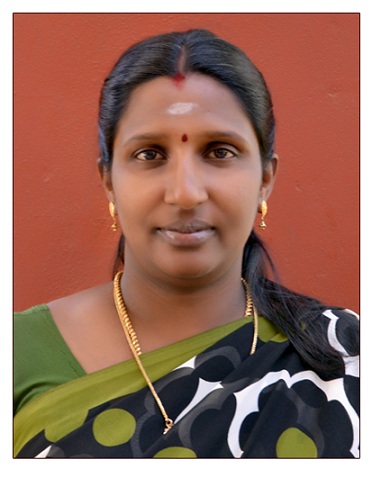
Dr. Senthilrani S
For most commuters in Tamil Nadu, the morning journey is a time for quiet reflection or the daily news. For Dr. Senthilrani S, an Assistant Professor in the EEE Department at Thiagarajar College of Engineering, those hours have become a mobile classroom. With 21 years of teaching experience, she might have been expected to always have the answers. Instead, she has spent the last seven years rediscovering what it means to be a student.
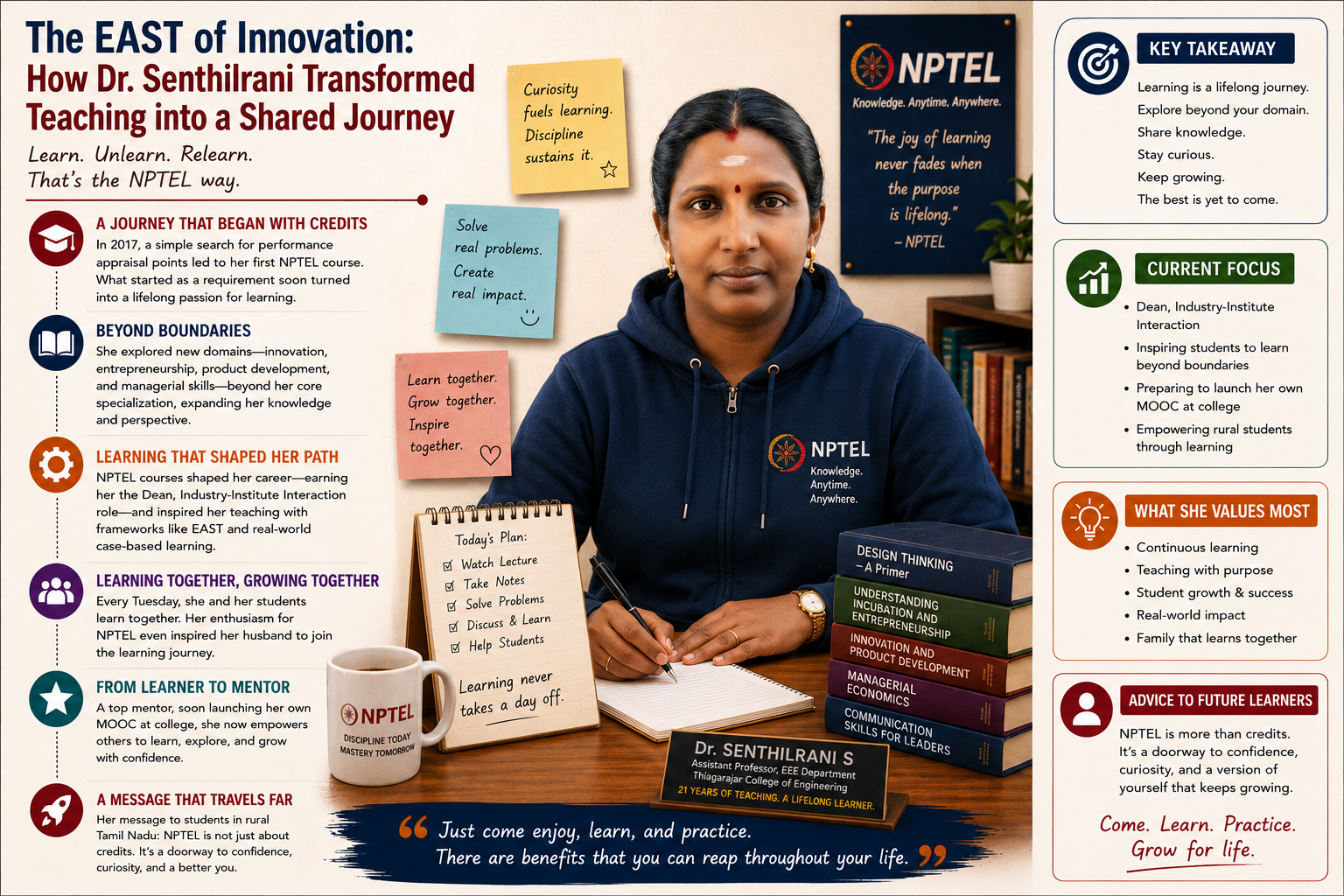
Her journey began in 2017, shortly after she completed her PhD. Like many faculty members, her first encounter with NPTEL was practical: she needed performance appraisal points. A casual Google search for credits, she thought, nothing more. But something shifted after that first course. “Initially it was purely for performance appraisal,” she admits, “but after completing the first course, I changed my view. Out of passion, I started to explore.”
What followed wasn’t a detour; it was a deliberate expansion. Rather than staying within her primary specialization, Dr. Senthilrani moved into multi-disciplinary territory: innovation, product development, entrepreneurship, managerial skills, domains she had never formally studied during her undergraduate or postgraduate years.
The knowledge didn’t stay confined to her notes. It opened a door she hadn’t known to look for.
She was eventually assigned to be the Dean of Industry-Institute Interaction portfolio, a role she credits directly to the management and industry-focused courses she completed through NPTEL. A credential she had once pursued casually had quietly reshaped her career.
Two mentors left a lasting mark on how she now teaches. From Dr. Bala Ramadurai, a professor at IIT Madras whose NPTEL course on ‘Design Thinking’, she took the EAST framework: Empathize, Analyze, Solve, and Test. It’s the first thing she introduces when students begin a new project. From Professor B.K. Chakravarthy, from IIT Bombay, whose NPTEL course on ‘Understanding Incubation and Entrepreneurship’, she learned the rhythm of the case study and incubation management – a style of delivery she now mirrors in her own classroom.
Perhaps the most distinctive part of Dr. Senthilrani’s story is how learning became a shared ritual rather than a solitary pursuit. Every Tuesday, she and her students open their assignments together, working through concepts as a collective.
The line between teacher and learner deliberately blurs.
“Whenever I do a course, my students enroll first, and now they pull me to do that course,” she says with a smile.This communal spirit didn’t stop at the classroom door. At home, she brought the same enthusiasm with her, nudging her husband to explore NPTEL courses until he eventually signed up. What started as her own professional journey had quietly become a household one, with two people at different stages of life choosing, in their own way, to keep learning. A quiet reminder that learning doesn’t have to stop at the office door.
Today, she is no longer only a consumer of content. Having been recognized as a top mentor repeatedly, thanks to her students’ consistent performance, she is now preparing to launch her own MOOC through her college, following the very format that the professors who inspired her once used. Her message to those in the rural stretches of Southern Tamil Nadu is quiet but clear. The message she carries back to students is simple. NPTEL is not merely a credit system. It is a doorway to confidence, to curiosity, to a version of yourself that keeps growing. “Just come enjoy, learn, and practice,” she says. “There are benefits that you can reap throughout your life.”
~written by Elsa Prasad