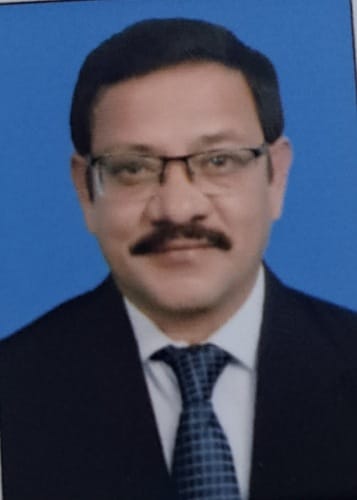
Paragjit Sarma
At the end of a long workday, when many professionals would close their laptops and call it a night, Paragit Sarma makes coffee and opens his course materials. The study window is modest – usually from 8:30 to 9:30 p.m. – but the ambition behind it is anything but. For him, learning is not a phase of life that ends with a degree, a promotion, or even retirement. It is a discipline, and increasingly, a family tradition.
An executive engineer in the Guwahati Division Coordination Office, located in New Delhi, he also serves as a public relations officer for the Brahmaputra Board, an organisation under India’s Ministry of Jal Shakti. Since joining the Board in 1989, he has watched water-resources management, infrastructure and public communication change dramatically. The shifts have been professional realities and a personal summons to keep pace.
In 2018, a message from an old schoolmate from his higher-secondary years introduced him to NPTEL. He enrolled the following year in ‘Construction Management’ and earned a result he describes without embarrassment: 58 percent. Rather than discouraging him, the mark revealed where he needed to improve. He changed his study habits, enrolled in two more courses and discovered that persistence could turn a course into a lasting habit of learning.
The breakthrough came with ‘Plastic Waste Management’, which he completed with 94 percent, topping the course. More important than the score was the connection between theory and practice. He found himself applying what he learned to his responsibilities, including waste-management practices of his residential colony. Courses in public speaking, soft skills and human-resource development proved equally valuable, strengthening the communication and administrative work that now sit alongside his engineering role.
From 2021 through 2025, he received consecutive recognition as an NPTEL Domain Scholar, including in Environmental Engineering and Construction Materials Engineering, along with other honours.Yet he speaks of certificates less as trophies than as “moral boosters”, evidence that experience can be sharpened by access to expert knowledge.
His learning has also travelled beyond the classroom. He credits his late mother, who encouraged him throughout his childhood, as a foundational influence. He has tried to pass that spark to his own family.
His son has completed 63 courses and surpassed his father’s record – a feat Sarma calls one of his greatest achievements.
His wife remains curious about the journey, while his daughter, pursuing an M.Sc. at Banaras Hindu University, has also enrolled. He smiles at the thought: theirs is an “NPTEL family.”
When study or work becomes difficult, he turns to cricket, often playing with his son. The game offers a reset, but not an escape from purpose. Within two years of retirement, he hopes to study even more, perhaps ten courses in a semester, and use that knowledge in the field and through the Institution of Engineers (India).
His advice to colleagues and juniors is direct: learn, wherever the opportunity exists. His own example makes the case more persuasively than any slogan.
At an age when many people begin to narrow their horizons, Sarma is widening his.
He is not chasing a final credential; he is building a habit that can outlast every title, assignment and deadline. “For learning,” he says, “there is no retirement.”
~written by Elsa Prasad