
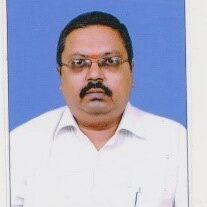
Dr V. Ramakrishna
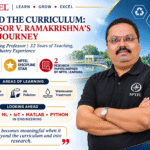
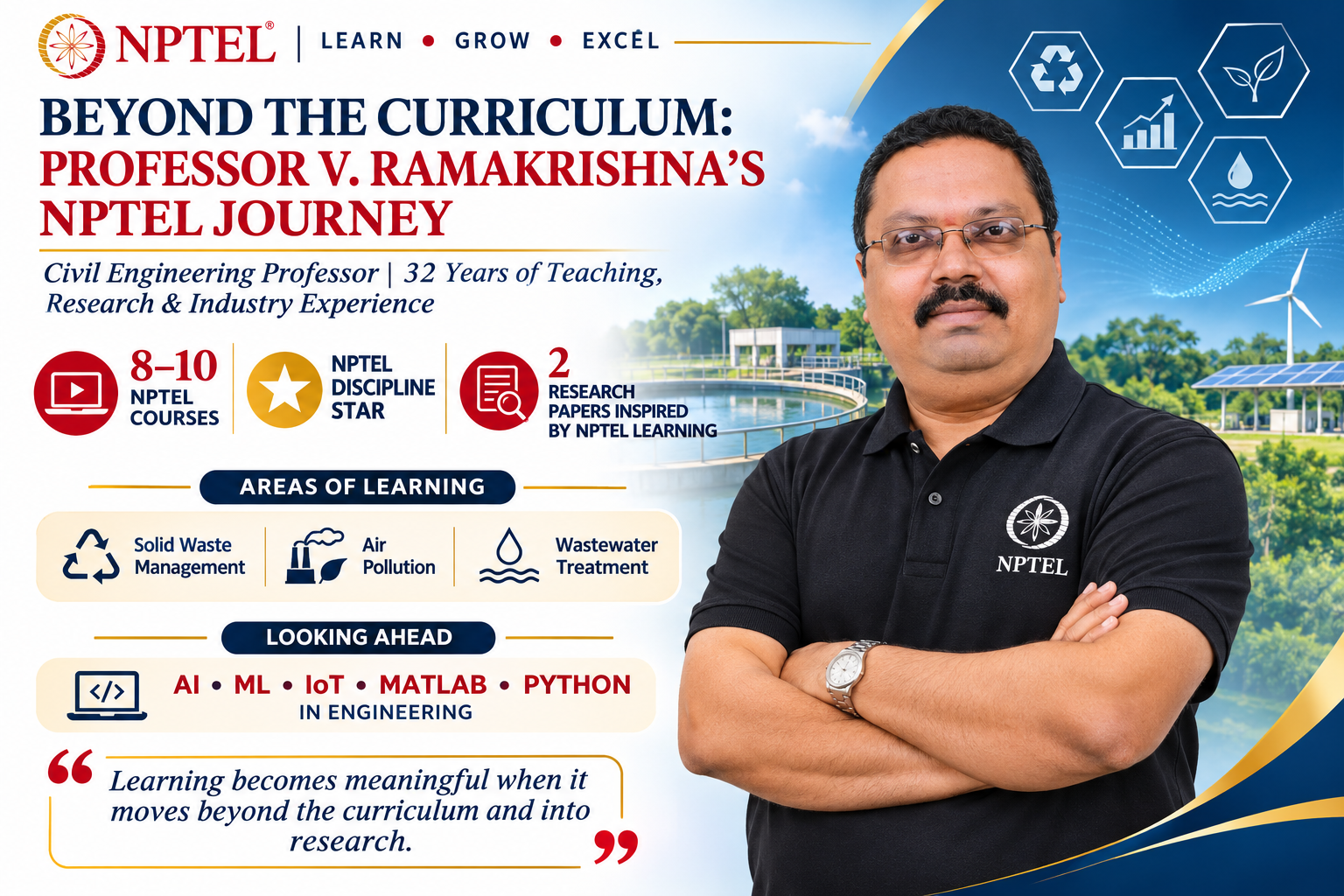
For Professor V. Ramakrishna, from an Autonomous Engineering College in Andhra Pradesh, the value of learning lies in what it makes possible beyond the classroom. A Civil Engineering Professor with 32 years of teaching, research and industry experience, he turned to NPTEL to explore subjects that conventional undergraduate curricula could not fully cover. As an added bonus, this led to an institutional requirement to gradually become a way to strengthen his research and bring advanced knowledge into academic work.
Professor Ramakrishna completed his Ph.D. from BITS-Pilani in 2005 in Civil/Environmental Engineering and has spent much of his career in academia. He taught at BITS Pilani for 11 years before continuing in other academic roles in AP, eventually taking up his current position. Despite his extensive experience, he recognised that engineering education must keep pace with developments beyond the standard curriculum.
His NPTEL journey began around eight years ago with a course on ‘Outcome-Based Education’ and has since completed approximately eight to ten courses, exploring subjects that complement his teaching and research. For him, one of the platform’s strengths is its ability to make advanced topics accessible to faculty and students alike.
The impact became particularly clear when he explored courses related to Environmental Engineering.
Courses on ‘Solid Waste Management’, and ‘Air Pollution’ introduced advanced topics that contributed to two research papers he subsequently published, besides highlighting the prevailing current practices in these domains in class room.
The experience showed him how structured online learning could lead to work beyond the course itself, opening up new possibilities for research and academic projects.
Among the courses he found especially valuable was ‘Wastewater Treatment and Wastewater Management’. Such subjects have helped him look beyond what is covered in a regular B.Tech curriculum and identify topics that can be explored further through research and student projects. As he explains, the additional material available through NPTEL can help faculty and students move towards more advanced projects.
Balancing courses with professional responsibilities has not been particularly difficult for him. He often begins with the course presentations, which he finds comprehensive and illustrative, and turns to the videos or additional material when he needs a deeper explanation. This approach allows him to learn without setting aside the considerable time required for teaching and other academic commitments.
His efforts have also earned him recognition as an NPTEL Discipline Star. For Professor Ramakrishna, however, the significance of the platform extends beyond individual achievements. His institution encourages faculty members to take NPTEL courses and share the knowledge with students, creating opportunities for learning to reach further into the academic community.
Looking ahead, he hopes NPTEL will bring IoT, Artificial Intelligence, Machine Learning applications, Matlab, Python etc., into conventional engineering subjects. Rather than treating emerging technologies and programming languages as separate areas of study, he believes integrating them with the established disciplines could benefit undergraduate students, postgraduate learners, research scholars and faculty members.
Having taught at BITS Pilani in an academic friendly environment, and worked in academia for many years, he sees NPTEL as offering a standard of learning that can complement classroom teaching and encourage continuous learning practices.
His experience has reinforced a simple conviction: engineering education becomes more useful when foundational knowledge is connected to emerging technologies and research.
~written by Sania K J