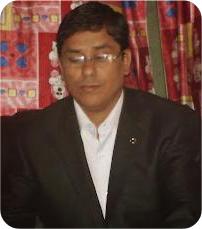
Gopal Charan Behera
If you open your eyes anywhere in India today, Dr. Gopal Charan Behera will tell you what you see: concrete. Bridges, columns, walls, floors – a civilisation held together by a material most people never think about. He has spent thirty-three years thinking about almost nothing else, first as a student, then as a researcher, and for the last three decades as a teacher of civil engineering at the Government College of Engineering, Kalahandi, Odisha. By the time he found NPTEL, he had already been in a classroom, on one side or the other of the desk, for nearly as long as many of his students have been alive.
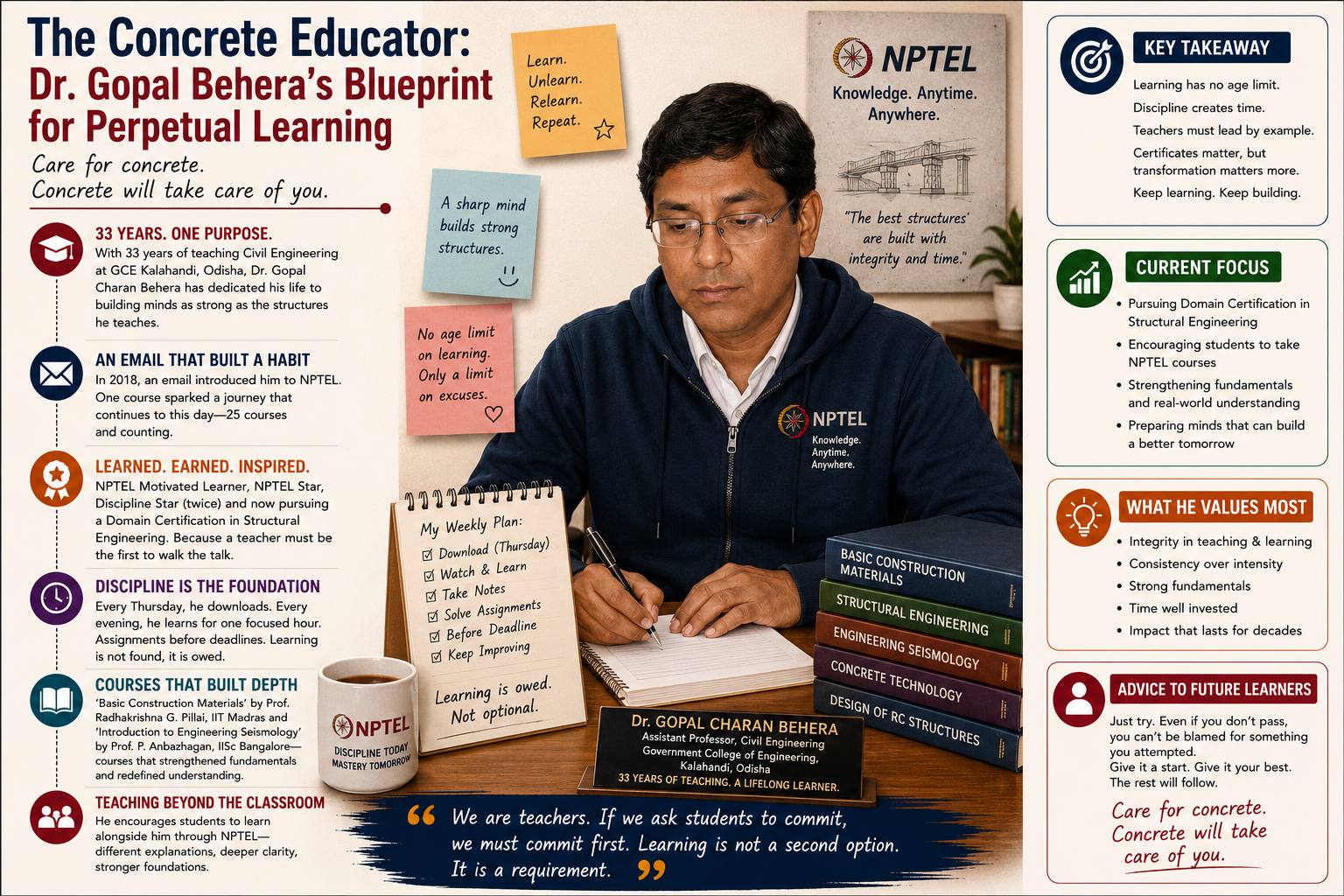
He came across NPTEL in 2018, almost by accident, through an email. That was enough. He enrolled in his first course and has not stopped since. It was not a leap of faith for a newcomer – by then, he already held a B.Tech from the College of Engineering, an M.Tech from Bengal College of Engineering Howrah, and a PhD from NIT Warangal. Twenty-five completed courses later, he holds multiple recognitions: NPTEL Motivated Learner, NPTEL Star, Discipline Star twice, and is currently working toward a domain certification in Structural Engineering. Taking certification seriously was, for him, a matter of professional honesty.”We are teachers,” he says. “When we tell our students to appear for the exam, why should a teacher not do the same for themselves?” For him, a teacher who asks students to commit to something they themselves avoid is not being a role model.His study routine is unglamorous and consistent. Every Thursday he downloads the week’s course videos. In the evenings, he gives NPTEL one hour, not the TV, not idle time, just one focused hour. Before the assignment deadline, everything is done. “If we say we are not getting time,” he says, “it is meaningless. A woodcutter sharpens his axe for four hours to cut wood for one. A teacher standing in a classroom for one hour should prepare for three or four.” He strongly believes that time for learning is not something you find. It is something you owe.
Among the twenty-five courses, two stood out. ‘Basic Construction Materials’ by Professor Radhakrishna G. Pillai, from IIT Madras, laid the fundamentals out with patience before formulas. ‘Introduction to Engineering Seismology’, by Prof. P. Anbazhagan from IISc Bangalore, returned him to first principles in a subject he thought he already knew. What NPTEL gave him was not new information, but a deeper grip on what was already there: the why behind the what. That shift has carried into how he teaches. He now encourages students to take NPTEL courses parallel to his own classes, not as supplementary material, but as a different voice explaining the same thing from the ground up.
Near retirement now, colleagues sometimes ask how he still finds motivation and his answer is simple: there is no age limit on learning. The certificates matter, yes, but the credential is not the point – it is what happened between enrolling and receiving it. His advice to anyone on the fence is short: try. Even if you do not pass, you cannot be blamed for something you actually attempted.
“Learning is not a second option,” he says. “It is a requirement.”
He closes with the line he lives by, a Civil Engineer’s worldview in one sentence: “Care for concrete. Concrete will take care of you.” A structure built with integrity will serve for fifty years. A student taught with seriousness will carry that for a lifetime.
What you put in carefully and honestly holds.
~written by Elsa Prasad