
Dr Saurav Mitra
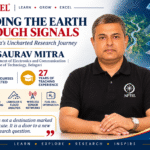
Reading the Earth Through Signals: Saurav Mitra’s Uncharted Research Journey
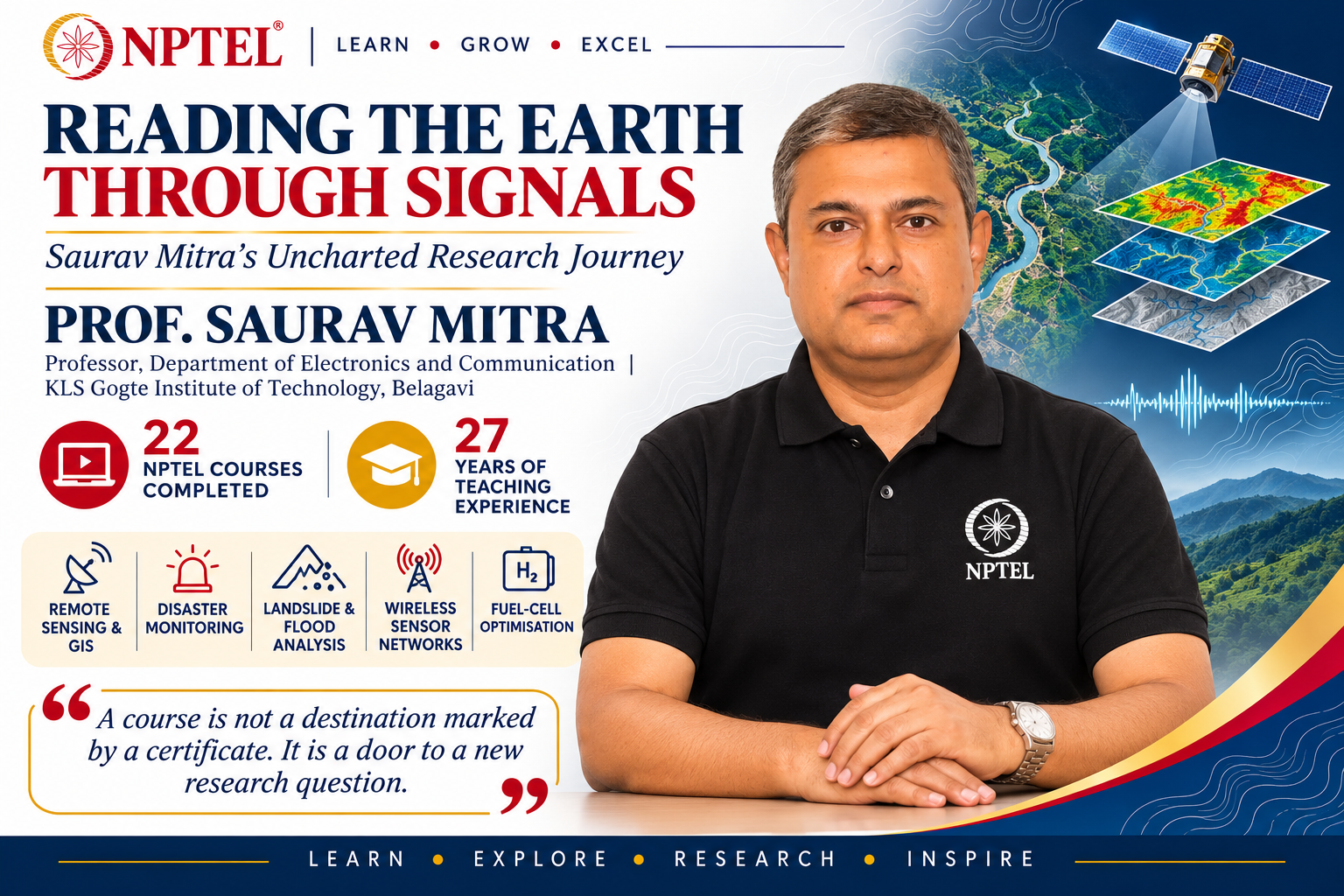
A fuel cell has parameters to optimise. A river has patterns to trace. A remote landscape has unknown mysteries to reveal. Professor Saurav Mitra’s research journey brings these seemingly distant worlds together, proving that an engineer’s curiosity can travel far beyond the boundaries of a discipline.
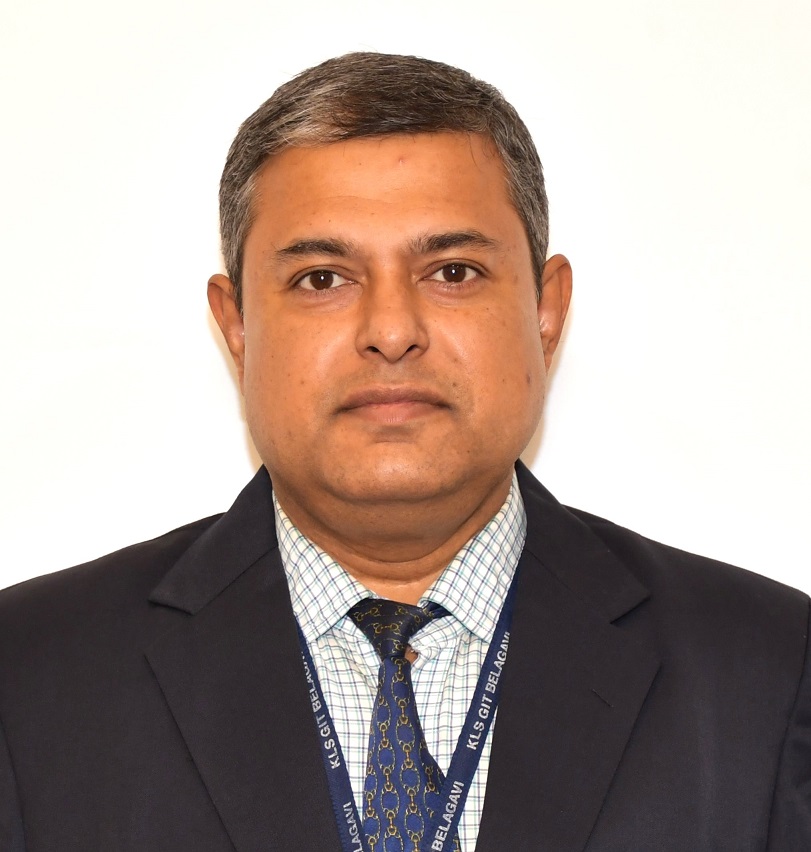
With nearly 27 years of teaching experience, he is currently a Professor in the Department of Electronics and Communication at KLS Gogte Institute of Technology, Belagavi, Karnataka. After completing his engineering degree as university gold medallist in 1999, he pursued a M-Tech in Instrumentation Engineering before joining IIT Bombay for his PhD in 2009 as a Crompton Greaves Research Fellow. His doctoral thesis included work related to fuel-cell optimisation, drawing on wireless sensor networks for parameter estimation and performance optimisation.
His research trajectory, however, had just begun.
In 2023, the two-month NNRMS course in Remote Sensing and GIS at IIRS-ISRO, Dehradun, opened an entirely new window for him. Natural hazards and disaster monitoring soon became his primary research interests, with his work spanning landslides and ongoing investigations into floods.
From optimising the performance of a fuel cell to tracing the vulnerabilities of an entire landscape in Western Maharashtra, his technical expertise acquired a whole new purpose.
The turning point came when his project students explored satellite-based data analysis for irrigation and agriculture related facilities, and won a national level competition. They wanted to investigate rainfall, soil moisture, and water availability around Belagavi, Karnataka. For Electronics and Communication engineers accustomed to collecting measurements through physical sensors, satellite data offered a new way to investigate these questions. This was an opportunity to bring together his students’ curiosity and his own training in remote sensing and GIS. Soon, they were examining drought and flood conditions across North Karnataka and investigating what satellite observations could reveal about its changing landscape.
NPTEL has contributed immensely to this expanding intellectual toolkit. His first NPTEL certified course was ‘Remote Sensing and GIS for Rural Development’. Later, he enrolled in ‘Non-Linear and Adaptive Control’ to support his teaching involving electric hybrid and unmanned vehicles. Although he had spent years encouraging students to pursue NPTEL certifications, he had not taken the examinations himself. That changed in 2025. After his first NPTEL certification in April 2025, he continued the pursuit, completing 22 courses in 2 years.
For Dr Mitra, the real dividend of online learning is measured in what happens next. A course on ‘Climate Hazards and Disaster Mitigation’ by Professor Priyank Sharma of IIT Indore impressed him through its case studies and multi-dimensional teaching approach. It led him to contact the professor, eventually opening doors to a research support that now supports him and his Ph.D. student, also a faculty member.
The classroom has evolved alongside his research. He shares relevant NPTEL courses and lecture slides with students, recommending ‘Sensors and Actuators’ to supplement their curriculum and ‘Network Analysis’ to strengthen their understanding. For him, a course is not a destination marked by a certificate. It is a door that may open into a classroom today and an entirely new research question tomorrow.
His advice to students reflects this philosophy: learn to understand the system and processes around you, not merely to pass. Knowledge finds its true value when it enters real life. And whatever the task, approach it with faith in your teacher and complete devotion.
Perhaps that is what keeps his own journey moving: the conviction that learning is not an item to tick off a list, but a discipline to live by.
~written by Khushi