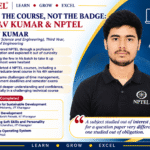

Abhinav Kumar
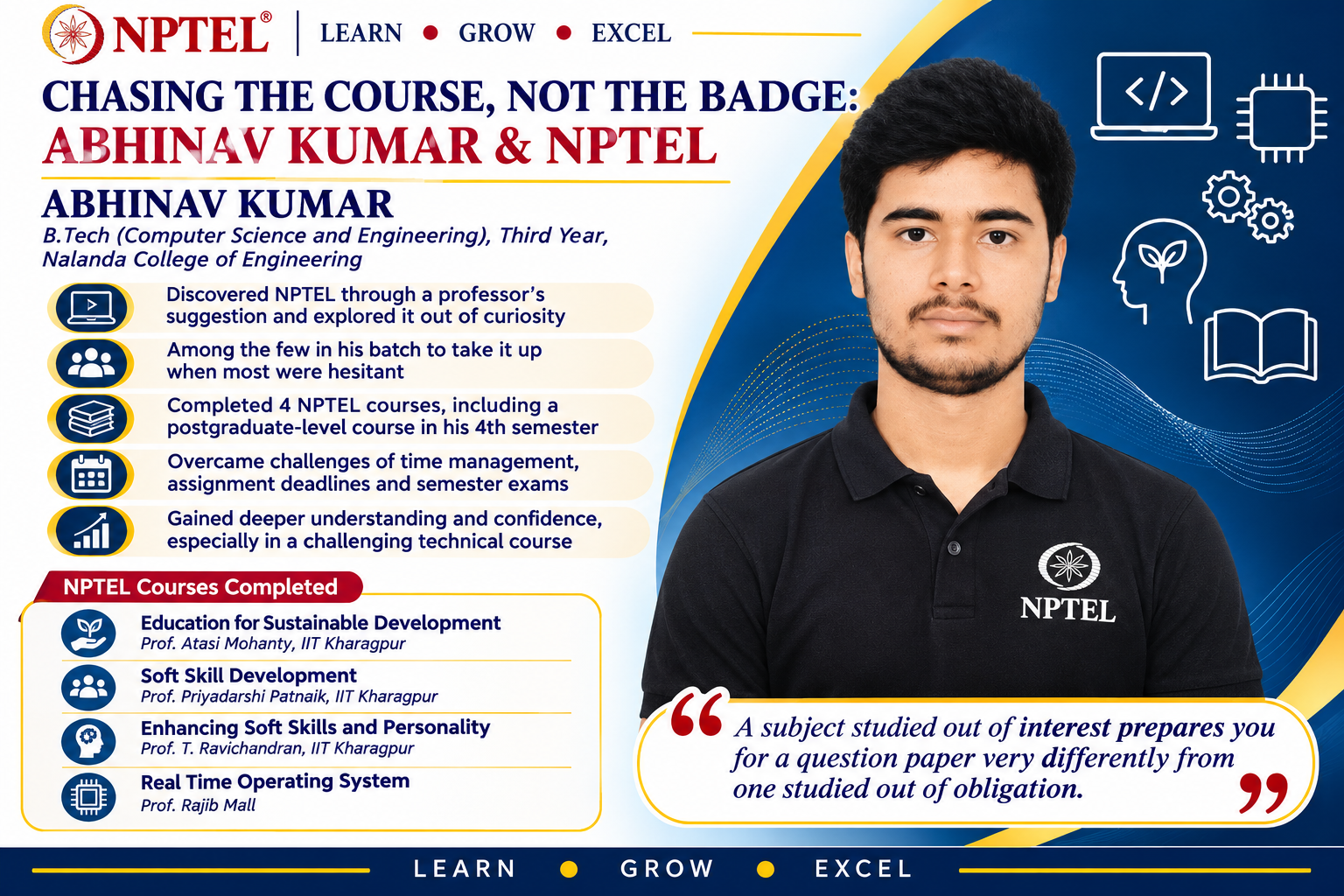
A third-year student of Computer Science and Engineering at Nalanda College of Engineering, Abhinav Kumar had never heard of NPTEL until his professor asked the batch to enrol in it. He says, without embarrassment, that he was not the only one hearing the name for the first time.
The courses on offer were non-departmental, and for most of his batch, that made them feel like surplus work rather than an opportunity. Very few students were eager to begin. Abhinav was not eager either, but he was curious, which turned out to be the more useful of the two. He sat with the NPTEL website for close to an hour, moving through the different categories of courses, working out what the platform was and how it functioned. Then he went looking for opinions, videos, and reviews. The more he read and watched, the more his curiosity grew.
At that point, he still had no idea what an NPTEL Star was. It did not matter to him. He was chasing the thing itself rather than the badge attached to it, and when the time came to register, he picked the course most of his friends had picked: ‘Education for Sustainable Development’, taught by Professor Atasi Mohanty of IIT Kharagpur.
That first course set the pattern for everything that followed. Abhinav watched every lecture, took notes as he went, and found himself genuinely delighted to be learning from a professor of IIT Kharagpur.
After sustainable development came ‘Soft Skill Development’ with Professor Priyadarshi Patnaik of IIT Kharagpur, then ‘Enhancing Soft Skills and Personality’ with Professor T. Ravichandran, and finally ‘Real Time Operating System’ with Professor Rajib Mall.
‘Real Time Operating System’ was a postgraduate-level course, built for learners with a background in Electronics, Electrical or Computer Science engineering. Abhinav was in his fourth semester of an undergraduate degree. He had registered in a hurry and had not read the course description closely enough to look at the prerequisites. What convinced him he was in the right place was the first lecture, which he understood so well that he simply assumed the course had been designed for undergraduate students.
This technical course turned out to be the hardest of the four, and the one he remembers most fondly for that reason. Programming had never been his strongest area, and this one asked for more than the others did. It pushed his boundaries and pulled him well outside his comfort zone. He finished it anyway.
The bigger struggle was time. The fourth semester, running from January to June, meant his regular coursework and four parallel NPTEL courses were competing for the same hours. He was not used to the assignment cycle and missed a few deadlines early on. The first weeks felt manageable. Later, with semester examinations approaching on one side and weekly deadlines on the other, it became genuinely difficult to hold everything together. He kept going, and the effort showed up where it counted – in results that were extremely good across the board.
The memory he keeps returning to, though, is not the score sheet. On exam day, while classmates around him were visibly nervous about what lay in front of them, Abhinav was calm about every subject he was taking. He describes it as a strange and pleasant feeling, something close to extra happiness. It makes a certain sense.
A subject studied out of interest prepares you for a question paper very differently from one studied out of obligation.
~written by Khadija Hussain