




Roshan Ghosh
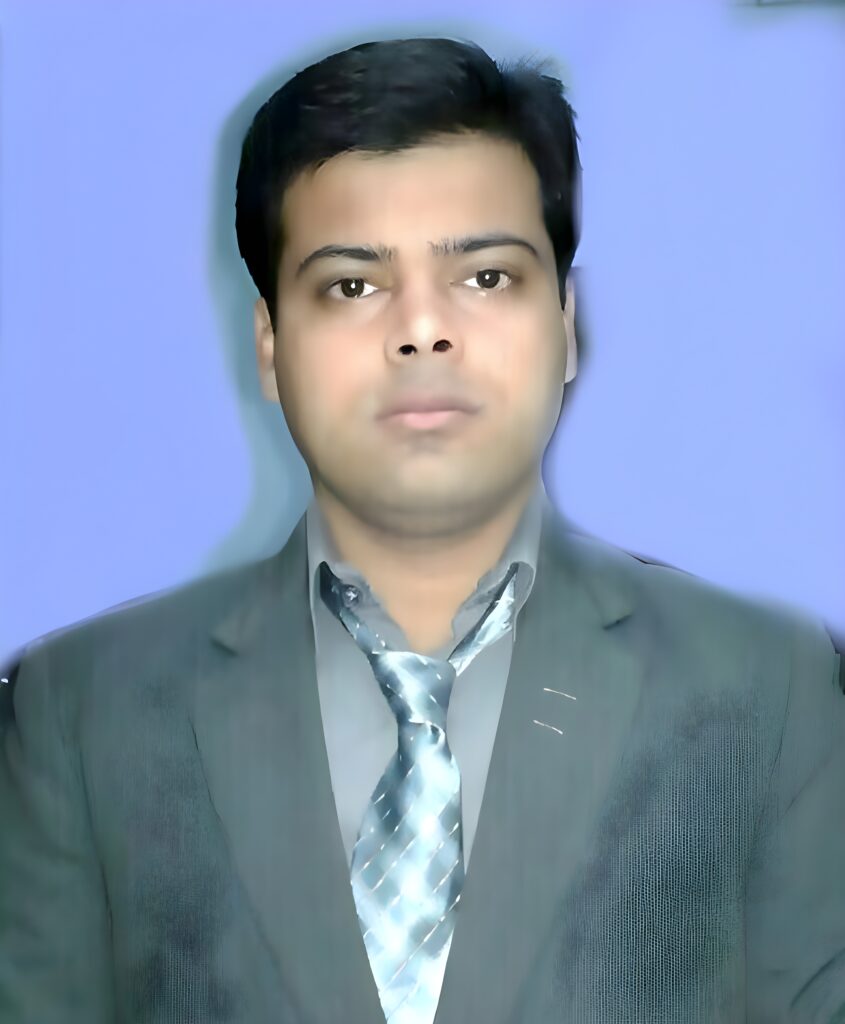
“My proudest moment was receiving an award in the presence of our former President, Shri Pranab Mukherjee.” For Roshan Ghosh, that moment marked one of the most important achievements of his academic journey. He had graduated as the departmental topper and gold medallist from Tripura University, where he did his M.Tech. But what he could not have known then was that another part of his journey, one that had begun years earlier with NPTEL, would shape the way he learned, taught and prepared for what came next.
It was 2012, and Roshan had hit the kind of wall every engineering student eventually hits – core subjects that were explained in the classroom but never quite clicked. NPTEL gave him access to professors from across the country who made difficult concepts easier to understand. He watched because it helped. Certification came later – in 2018; six years after starting. His priorities were sorted.
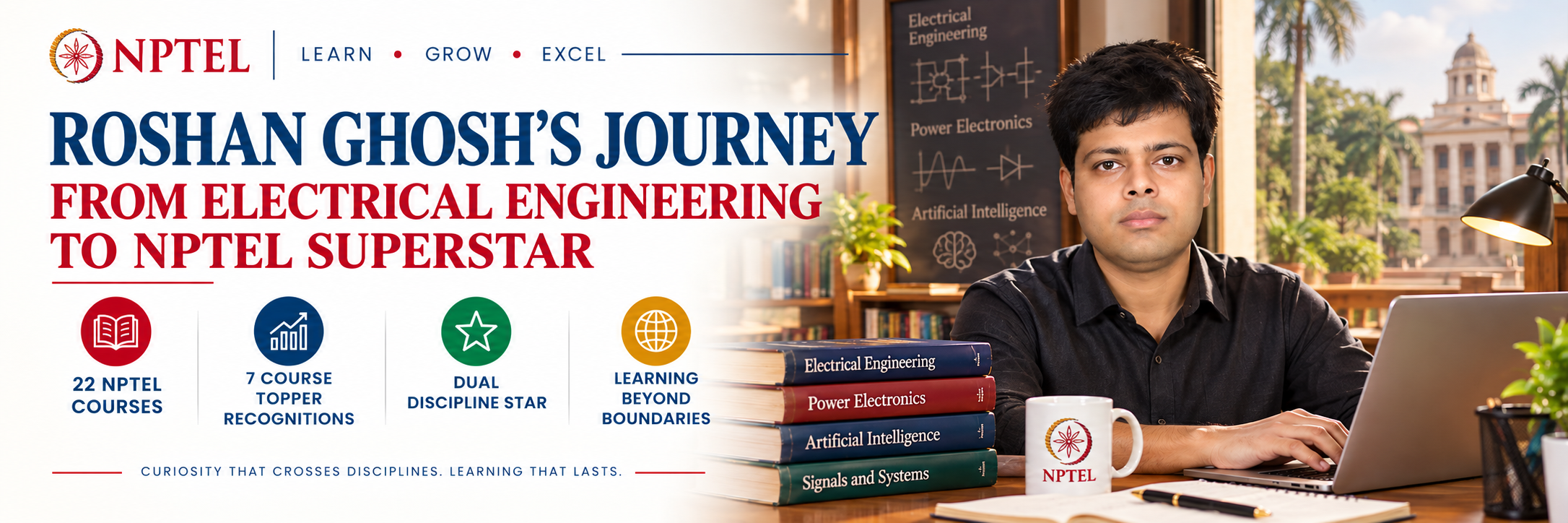
Today, Roshan has 22 NPTEL courses behind him, spread across three domains: Power Systems and Power Electronics, Artificial Intelligence, and Faculty Development . Along the way, he’s earned seven Course Topper recognitions, dual Discipline Star honours in Electrical Engineering, and Computer Science & Engineering, and the NPTEL Superstar title. But numbers only tell you so much. What’s more interesting is why an electrical engineer by training, who kept walking into subjects he had no obligation to touch, built an entirely new skill set in AI simply by staying curious.
His favourite courses include ‘Electrical Machines’ by Tapas Kumar Bhattacharya of IIT Kharagpur, ‘Power Electronics’ under Professor L. Umanand at IISc Bangalore – “very, very, very good,” he recalls – and ‘Education Leadership’ by Professor Mohanty from IIT Kharagpur. Among the hardest were ‘Artificial Intelligence and Knowledge Implementation and Reasoning’ by Professor Deepak Khemani at IIT Madras, with one course seeing barely 5–10 percent of students pass.
“Handling such courses and such rigor makes you strong to handle real-life challenges,” he says. Every difficult problem worked through, he believes, changes how you approach the next one – technical or otherwise.
None of it came easy on the calendar, either. Between full-time teaching and an HOD’s administrative load,
Roshan carved out his NPTEL hours on weekends and admits that assignments were always “the last ballgame,” solved on Wednesday evenings after returning from college. “We engineers are like this,” he laughs. “We solve problems at the last moment.”
The platform that once helped him understand difficult concepts became something he could carry into the classroom for students facing the same difficulty. As the HOD of both Electrical Engineering and Electronics & Telecommunication Engineering (Diploma) at Budge Budge Institute of Technology, he now encourages his students and colleagues to explore NPTEL. Several colleagues have already picked up two or three courses of their own, extending that culture of learning beyond his own classroom.
He is now pursuing a PhD on the interdisciplinary application of soft computing in power systems and for him learning has never been about staying within one discipline. His own journey from Electrical Engineering to AI and interdisciplinary research reflects that belief.
When asked what he would say to the people behind NPTEL, he says, “Keep it alive. It gives students who may never study at an IIT access to some of the country’s best professors. That access is what makes NPTEL worth protecting.”
He began by sitting through lectures to understand difficult concepts. More than a decade later, he is still choosing the harder subject, the unfamiliar field and the next thing he doesn’t yet know.
– Written by Shambhavi Shekhar