
Dr Chetana Hegde
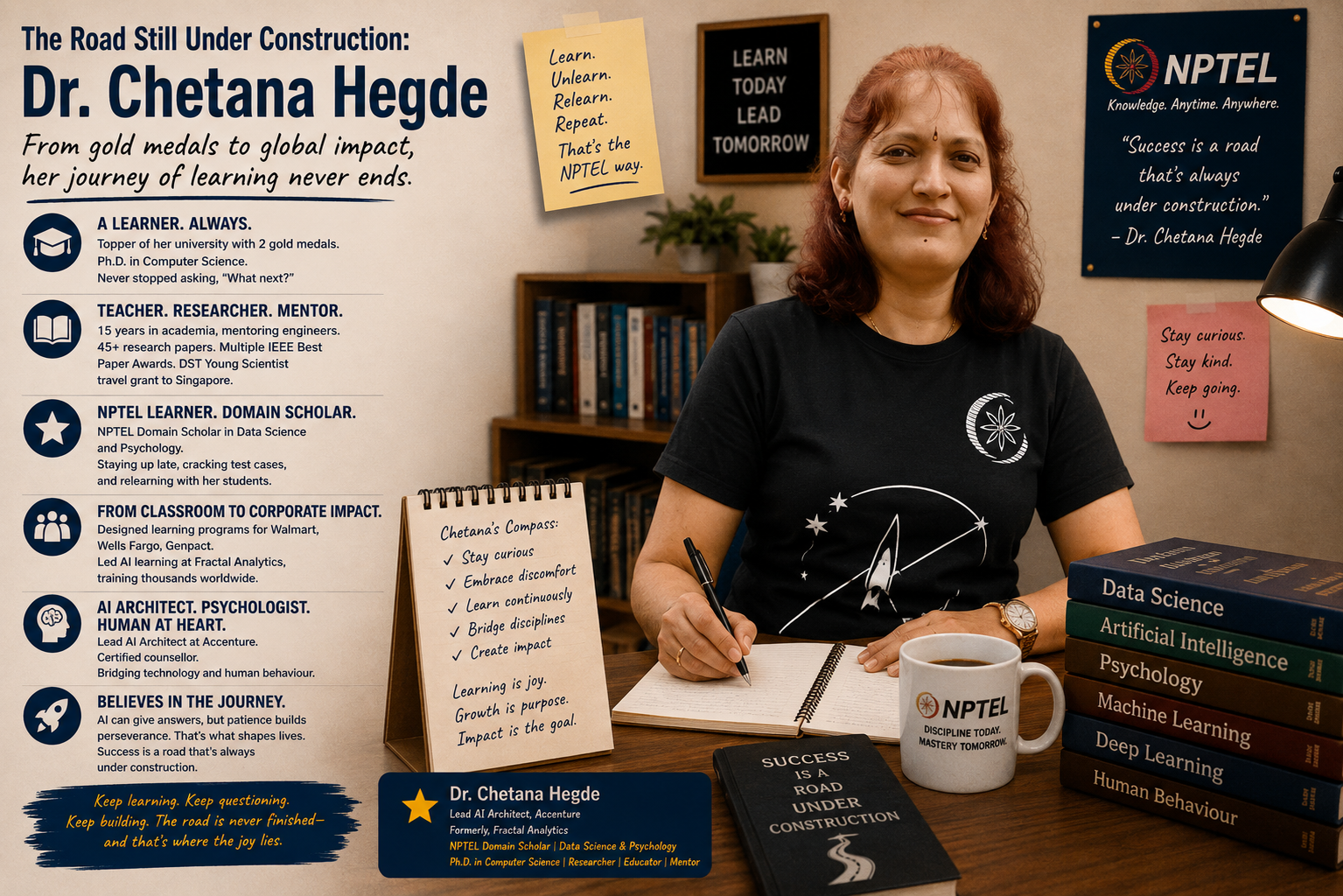
The day I spoke with Dr. Chetana Hegde was her last at Fractal Analytics. Three days later, she would begin a new chapter at Accenture as a Lead AI Architect. It felt fitting. We weren’t just talking between two jobs, but in the brief pause between one chapter and the next. That coincidence seemed to capture her journey perfectly.
“Success is a road that’s always under construction.”
That’s the line she keeps on her LinkedIn profile. After listening to her story, it no longer felt like a catchy quote but like a philosophy she has lived by. Here was someone who topped her university with two gold medals, earned a Ph.D. in Computer Science, built a successful academic career, yet never treated those milestones as destinations. Instead, she kept asking herself one question: What next?
That question shaped her career. After topping her university in B.Sc., she pursued an MCA, worked as a software developer, then spent nearly fifteen years teaching engineering students while completing her M.Phil. and Ph.D. Along the way, she published over 45 research papers, received multiple IEEE Best Paper Awards, and earned the Department of Science and Technology’s Young Scientist travel grant to present her work in Singapore. Later, she became an NPTEL Domain Scholar in Data Science and, more recently, in Psychology – two seemingly different disciplines that would eventually converge in her work.
Picture an experienced professor in her forties, staying up late trying to crack hidden test cases before an NPTEL assignment deadline. She laughed while recalling how she would compete with her own students, travel with them to exam centres, and rediscover what it felt like to be a learner again. Dr. Hegde reminds us that it never does; you simply become more willing to embrace the discomfort of not knowing.
NPTEL didn’t just introduce her to new subjects; it opened doors to an entirely new career. Her growing expertise in artificial intelligence led her into corporate learning, where she designed programmes for organisations including Walmart, Wells Fargo, and Genpact, before leading AI learning initiatives at Fractal Analytics. There, her team developed large-scale AI courses that trained thousands of employees for a global healthcare client. Around the same time, she ventured into psychology, becoming a certified counsellor and discovering how technology and human behaviour could complement one another.
Perhaps that’s why someone whose career now revolves around AI is also one of its most thoughtful critics. Not because she doubts the technology, but because she understands how people learn. Dr. Hegde often finds herself looking at today’s learners through two very different lenses – that of an AI professional and the other of a psychologist. One tells her that technology will continue to become more powerful. The other reminds her that people don’t grow by finding answers instantly; they grow by wrestling with questions. That’s why she worries when students jump straight to AI-generated solutions without understanding the logic beneath them.
The hours spent debugging, failing, trying again, and finally getting it right don’t just produce better programmers, they build patience.
And, as she believes, the patience developed while working through a difficult problem becomes the same patience that helps us navigate uncertainty, setbacks, and life’s many challenges. AI can generate answers, but it cannot cultivate perseverance. That, she believes, still has to be earned.
When I asked how she kept learning through demanding jobs and everyday responsibilities, her answer wasn’t about discipline or productivity hacks. She spoke about waking up before sunrise, reading widely beyond technology, walking long distances, and finding genuine joy in learning itself. She even joked that courses were her source of dopamine. But behind the humour was something profound: for her, learning was never a means to an end. It was the end in itself.
Maybe that’s why her LinkedIn line feels less like a quote and more like one of life’s truths. Success isn’t a destination we arrive at; it’s something we keep building. Dr. Hegde’s journey reminds us that the most remarkable learners aren’t defined by how much they already know, but by how excited they remain to discover what comes next.
~written by Shambhavi Shekhar