

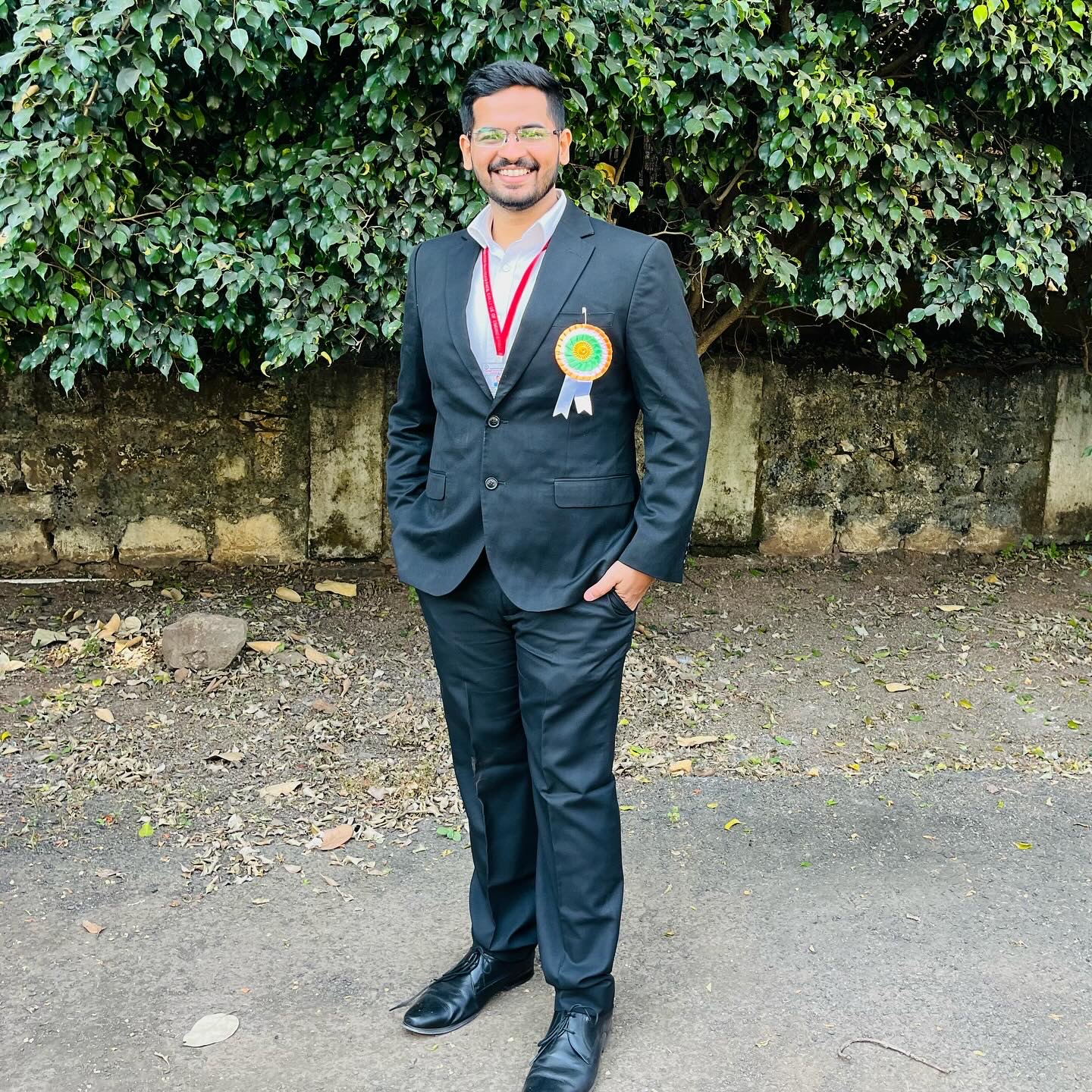
Alok Kadam
An Assistant Professor in Civil Engineering at Karmaveer Bhaurao Patil College of Engineering, Satara, Alok completed his B.Tech at VJTI, followed by an M.E in Construction and Management from Savitribai Phule Pune University. He discovered NPTEL at the beginning of his teaching career. What drew him was the opportunity to learn from faculty at IITs and IISc, regardless of geographical limitations. His primary goal was to strengthen his technical knowledge and bring fresh academic perspectives into his classroom.
His first attempt at NPTEL certification, however, did not go as expected.
In 2022, he enrolled in the course ‘Concrete Technology’. Having performed well in the subject during his degree, he was confident in his understanding of it. Yet he did not receive a certificate. While the subject was familiar, the certification criteria were not. Unaware that his assignment score fell short of the requirements, he had not anticipated the outcome. Instead of relinquishing, he familiarised himself with the platform’s assessment requirements. His next course, ‘Energy Conversion Technologies (Biomass and Coal)’, earned him his first NPTEL certification.
Over time, the courses began influencing his teaching methods as well. The course ‘Instruction for Good Learning’ prompted Alok to reconsider how he prepared for lectures and evaluated his students.
The impact became more tangible when NPTEL learning found its way into his own syllabus. While teaching Urban Planning, he was also taking NPTEL’s ‘Smart Cities’ course. He felt the existing syllabus could benefit from newer concepts. “It could only be a great foundation, but including concepts from Smart Cities will help students in the field as civil engineers.” Similarly, ‘Drone Surveying’ helped him deepen his students’ understanding of remote sensing and its practical applications, a key topic in Geomatics Engineering.
Alok encourages his students to explore NPTEL courses as per their interests, beyond the university curriculum. He also incorporates selected NPTEL lectures into his classes, alongside resources such as YouTube and Kahoot. The aim is to make learning more interactive. Over time, he has observed greater student participation and an improved ability to connect theory with practice.
For him, one of NPTEL’s most significant contributions has been the habit of structured learning. In conventional academic settings, we often study a topic only to meet an exam requirement. But through lectures, assignments, quizzes and exams, he began approaching learning more systematically. Gradually, the platform became less about reaching the end of a course and more about sustaining the process of learning.
Learning is a continuous process, and continuity requires consistency. He uses the Marathi word Saatatya to describe what keeps him going: the commitment to continue, return and to learn again.
“In order to become a good learner, you have to become a good listener and a good observer first. And choose that repeatedly.”
Having received NPTEL Star recognition in three categories – Motivated Learner, Believer, and Discipline – and attended two NPTEL meetups at IIT Bombay, Alok continues to explore the platform. Currently, he is enrolled in five courses. Courses like ‘Advanced Concrete Technology’ have helped him keep pace with developments in his field.
He hopes to inspire more students and faculty members to discover the same opportunities for themselves. One experience, in particular, reassured him that this idea is worth carrying forward. When a student from the CSE branch thanked him for an NPTEL course recommendation, he felt it. She claimed that it helped her participate more actively in her regular classes.
In his class, before moving on to a new lecture, he returns to the previous one. When students share their perspectives and ask questions, he sees learning continue beyond the classroom discussion.
Perhaps that is saatatya in its simplest form: not just the teacher’s willingness to keep learning, but the moment a student carries that learning forward.
~written by Khushi