
Sai Rupesh
When Sai Rupesh enrolled in the course ‘Analog Circuits’, he expected something rather different. A fan of analog watches, especially Rolex and Casio, he wished the subject might lead to something just as cool. Four weeks passed and he saw a new world uncover itself, an entirely different kind of “analog”.
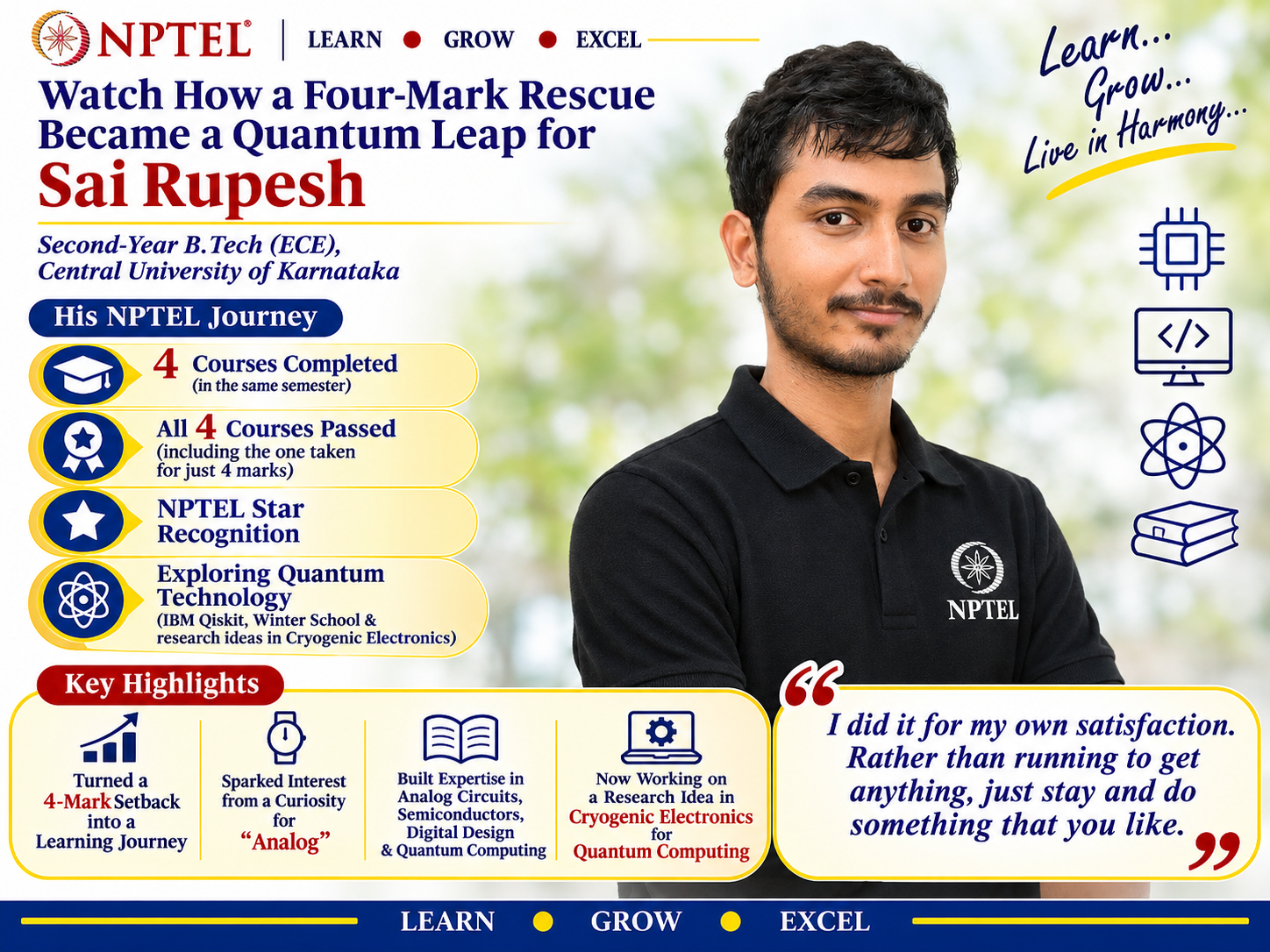
A second-year ECE student at Central University of Karnataka, Sai had come into engineering partly following a family path. In school, he says, he was often among the last few in class. After a drop year, he joined university with little confidence in his academic abilities. But conversations around him; friends discussing Embedded Systems, VLSI and Quantum Physics, made him increasingly aware of how much he did not know. In his case, it turned out to be a good thing. Then, in a basic Electronics internal examination, he fell four marks short. Remembering NPTEL from a YouTube video, he looked for a course that might help. “Just to get those four marks, I took the 12-week course,” he says, referring to ‘Fundamentals of Semiconductors’. A small academic setback had set something else in motion.
His uncle, a Math Lecturer, later handed him a thick bundle of notes and nudged him towards ‘Digital Design with Verilog’. A friend’s conversations about Quantum Physics made him curious enough to try an introductory course from IIT Madras. And there was ‘Analog Circuits’, picked partly because of his fondness for the word ‘analog’. Before long, he had enrolled in four courses, without quite knowing what he was getting into.
The timing was daunting. January 19, the day his first-semester exams began, was also the start date for all four NPTEL courses. He studied for college during the day and turned to NPTEL at night.
The library became a second home; only a few classmates and his roommates knew what he was attempting.
When friends learnt he had paid ₹4,000 to sit four exams, they asked, “Will you pass? Won’t the money be wasted?” There were moments when he wanted to give up. His mother, who is also a teacher, kept encouraging him, while he also learnt to steady himself. “I wanted to get an identity,” he says. “I wanted to prove myself.”
Then came the results. ‘Analog Circuits’: 62% and an Elite certificate. ‘Quantum Computing’: another 62% and another Elite certificate. ‘Digital Design with Verilog’: 69%. ‘Fundamentals of Semiconductors’, the course he had begun for four marks, came back with 53%. He had passed all four.
The certificates gave him a confidence he says he has not lost since. NPTEL Star recognition brought invitations to conferences, and his interests began moving further into Quantum Technology. He has since explored IBM Qiskit and other courses, attended a winter school, and begun shaping an idea around Cryogenic Electronics for Quantum Computing. He is now looking for the guidance and experience to develop it into research.
Sai says he studied mainly for marks and to avoid being scolded by the school staff. This time, he had followed a curiosity without knowing where it would lead.
“I did it for my own satisfaction,” he says, “Rather than running to get anything, just stay and do something that you like.” And as you leave Sai’s story, perhaps there’s a question worth carrying with you: what might you discover if you followed a curiosity without needing to prove anything to anyone?
~written by Khushi